Add life to years: feeding the gut microbiome for healthy ageing


This article has also been published on Food Navigator Europe – read more here.
By Dr. René Floris (Chief Innovation Officer) and Dr. Gabriele Gross (Principal Scientist Health & Microbiology).
Can food-based interventions modulate the gut microbiome to encourage healthy ageing and increase the number of years of good health?
People are living longer. In the Netherlands, for example, the percentage of the population over 65 has risen from 12.8% in 1990 to 20.8% in 2025. And this pattern is repeated across the globe.
But living longer doesn’t always mean more healthy years. Levels of age-related health issues – including neurodegenerative, cardiovascular, metabolic, musculoskeletal and immune system diseases – are rocketing. That’s a challenge for individuals and their environment. It’s also a problem for healthcare systems that are already struggling through over-demand and lack of resources.
“Consumers and healthcare systems are thinking more about ‘healthy ageing’. So rather than just adding more years to our lives, adding more life to our years. At NIZO, we’re asking: What can the food and nutrition industry do to help?” says Dr. Gabriele Gross, Principal Scientist Health & Microbiology at NIZO.
There are well-known links between nutrition and health. Eating plenty of fruit and vegetables, the right kind of fats, and not too much salt and sugar is familiar advice to avoid all kinds of long-term health issues. But can we go further? Can we help individuals and health systems alike through targeted interventions that focus on health span rather than lifespan?
The answer isn’t 100% clear – yet. But there is good reason to believe it will be yes.
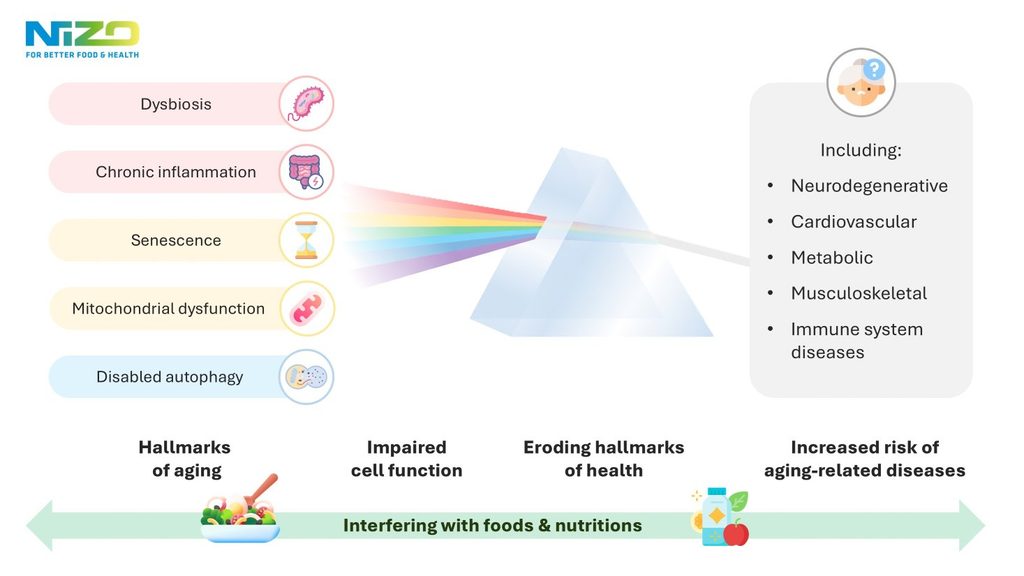
In recent years, researchers have identified numerous hallmarks of ageing. These are biological processes that are linked to impaired cell function and increased risk of age-related disease.
“These processes act throughout our lives, but the cumulative effects only become apparent with age. We can’t stop the processes entirely, but the goal of healthy ageing is to slow them down – or, at least, prevent them accelerating. If we can do this, we can, hopefully, delay the onset of age-related disease. And the earlier you can start, the greater the potential impact,” Gabriele explains.
“Some of the hallmarks of ageing are related to the internal functioning of cells, such as mitochondrial dysfunction or cell division. Others, like altered cell communication and chronic inflammation, act at the inter-cellular or organ level. One particularly promising target for dietary interventions is an imbalance in the gut microbiota do to changes in the relative abundance of different types of microorganisms.”
As we age, some microbes in the gut become more common and others less common. It has been suggested that specific changes may be linked to either healthy or unhealthy ageing – often through metabolites the microbes produce.
For example, Ruminococcus torques can degrade the gut’s mucus layer and produce para-cresol, both of which have been linked to an increased risk of inflammation and inflammatory bowel disease. Eubacterium rectale, on the other hand, produces butyrate, which can modulate inflammatory responses and may help reduce the risk of neuroinflammation and cognitive decline.
These findings suggest a possible approach to promote healthy ageing.
“If we in the food and nutrition industry can identify particular (edible) compounds that support a balanced microbiota composition or stimulate the production of particular metabolites associated with health, then we can open the door to a new world of targeted healthy ageing food products,” Gabriele points out.
The ability to substantiate any health claims is essential. Doing this directly for healthy ageing claims is extremely difficult. Companies cannot realistically run 30-year intervention studies.
However, there is indirect evidence to support the approach. On one hand, various cohort and longitudinal studies have found links between specific biomarkers and healthy ageing outcomes. On the other, the idea that we can modulate the gut microbiome with specific food components, such as particular fibres, and that this can lead to systemic health benefits is well accepted within academia and the food industry.
While this evidence provides an encouraging starting point, there are still gaps. The current evidence suggests a correlation between diet, microbiome and healthy-ageing benefits but causation is less clear. We need to look at particular dietary intervention and determine which specific microbiome changes they can induce and how this ultimately translates into relevant biomarkers for improved healthy-ageing outcomes.
In short, we need to better chart the pathway from food to microbiome to health effects. That relies on a strong molecular understanding of how food can modulate the gut microbiome. Which food compounds stimulate which microbes to produce which metabolites? And which metabolites promote healthy ageing effects?
“So far, the effect of nutritional interventions on outcomes such as sleep or immune system responses has mainly been studied over relatively short timeframes. We need to expand that research to processes that take place over decades, while keeping study timelines realistic. That means identifying more validated biomarkers that can be measured today and reliably predict future healthy-ageing outcomes,” Gabriele adds.
Doing so will help build the scientific framework needed to support future healthy-ageing innovations. This will require collaborative research efforts that draw on expertise from across industry and academia. NIZO is currently at the very early stages of creating one such consortium. It aims to integrate microbiome, metabolite, biomarker and intervention-response data to strengthen the evidence linking specific nutritional interventions to gut-microbiome changes and measurable indicators of healthy ageing.
Developing food interventions that promote healthy ageing is more than just a technical and scientific challenge. There is also a challenge to communicate the value of choices whose benefits lie decades in the future – and, even then, aren’t immediately obvious to consumers.
Stronger evidence linking food ingredients, microbiome changes and validated biomarkers will help manufacturers build more compelling healthy-ageing product propositions and demonstrate tangible benefits long before age-related conditions appear. That will be hugely important in encouraging consumers to start thinking about healthy ageing as early as possible and enjoy greater rewards later.
“Many of the biological processes associated with ageing begin decades before symptoms show up, so you can’t wait for symptoms before you act. And the sooner you start to act, the bigger the impact on your health span – adding more life to those later years,” Gabriele concludes.